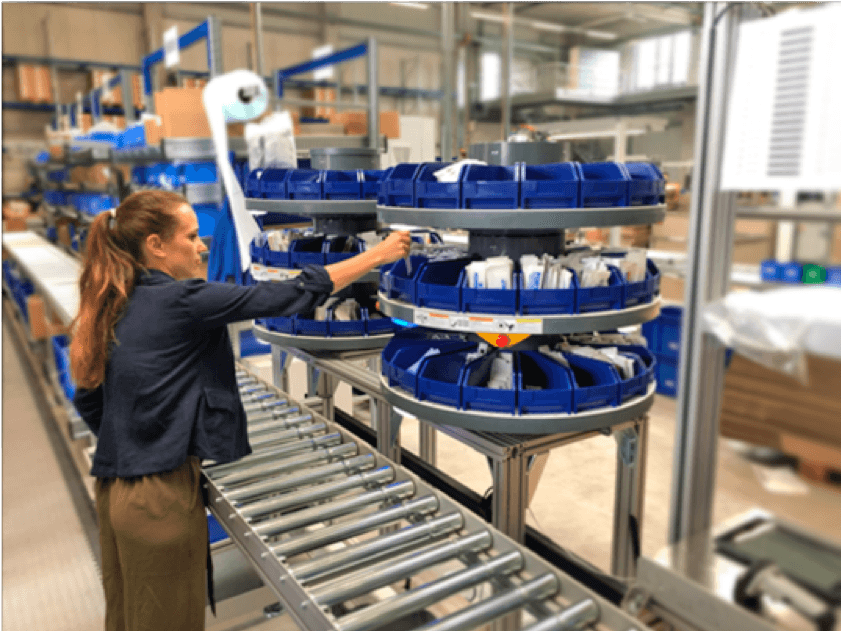
Pick-by-Light in Assembly: Preventing Errors Before They Happen
How light-guided assembly prevents picking and assembly errors at the source
In manual assembly, a single pick often decides the quality of the final product. If the wrong part is taken or a step is carried out in the wrong order, the error often only becomes visible during final inspection, when rework becomes expensive. Pick-by-Light addresses exactly this point: it guides the employee to the correct part with a light signal and prevents the error at its source, instead of discovering it later. This article shows how Pick-by-Light works in assembly and why it is more than just a picking aid.
What Is Pick-by-Light?
Pick-by-Light is a light-based guidance system for the manual removal of parts. At each material compartment, a light signal indicates which part is needed next, and the removal is confirmed via a sensor or button. Originally developed for warehouse picking, the principle is increasingly finding its way into assembly. The terms Pick-to-Light and P2L describe the same principle. What matters is not the name, but what the system achieves in the process.
From Picking to Error-Proof Assembly
In warehouse picking, Pick-by-Light mainly helps to find the correct compartment faster. In assembly, a second, more important dimension is added: error prevention. Because here, the part that is picked is installed immediately. A wrong pick does not just lead to an incorrect removal, but to a defective product. Pick-by-Light therefore intervenes one step earlier than any final inspection ever could: it signals the correct pick, immediately detects a mispick and reports it before the wrong part is installed. The error is prevented where it originates, instead of being corrected expensively at the end.
Process Locking: Making the Error Impossible
The real leap in quality happens when Pick-by-Light does not just give hints, but secures the process itself. With process locking, the digital sequence is coupled to the correct pick: if the employee reaches into the wrong compartment, the instruction stops and only continues once the error has been confirmed and corrected. The correct sequence is thus no longer just recommended, it is enforced. An error becomes not merely less likely, but simply impossible within the process, as long as the lock is active.
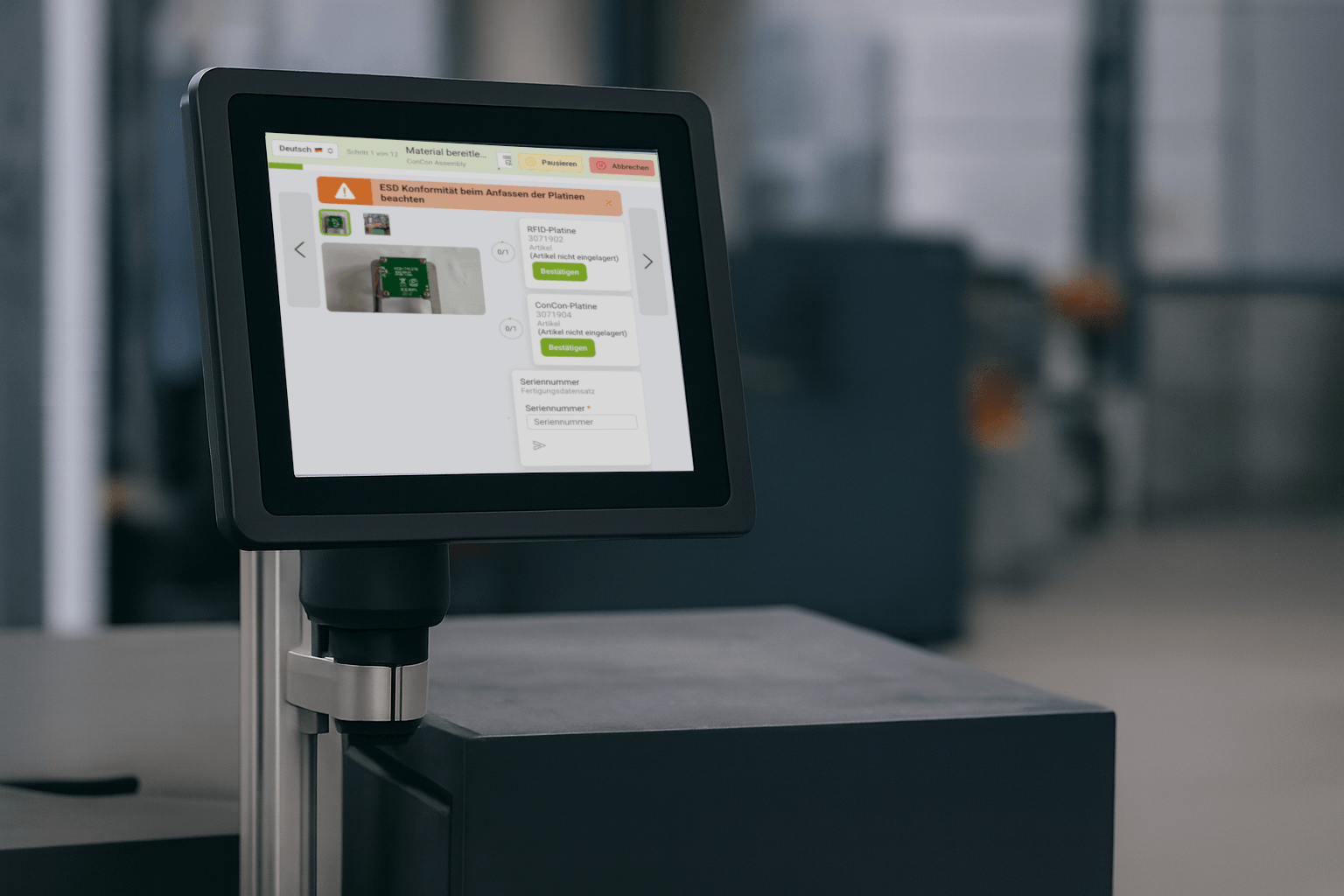
Strict Guidance or Subtle Support: A Question of the Target Design
How strict this guidance turns out to be is not a fixed property of the system, but a design decision that should be based on the goal. Both approaches have their place, and the right choice depends on what matters most in the given process.
- 1Focus on efficiency: If finding parts quickly is the priority, the light signal mainly serves as orientation. The employee is guided, but not strictly blocked. Process safety is still provided through the visual guidance, but deliberately stays in the background to keep the workflow as fast as possible.
- 2Focus on process safety: If a low error rate and seamless safeguarding are the priority, guidance is strict. A mispick blocks the process until it is corrected. This may slow the takt slightly, but practically rules out errors within the guided sequence.
In practice, this is not an either-or decision for the entire operation, but a choice made per process or even per work step. An uncritical step can be guided efficiently and unobtrusively, while a safety- or quality-critical step is strictly locked. The system should therefore align with the intended benefit, not the other way around.
Pick-by-Light as Part of Digital Worker Guidance
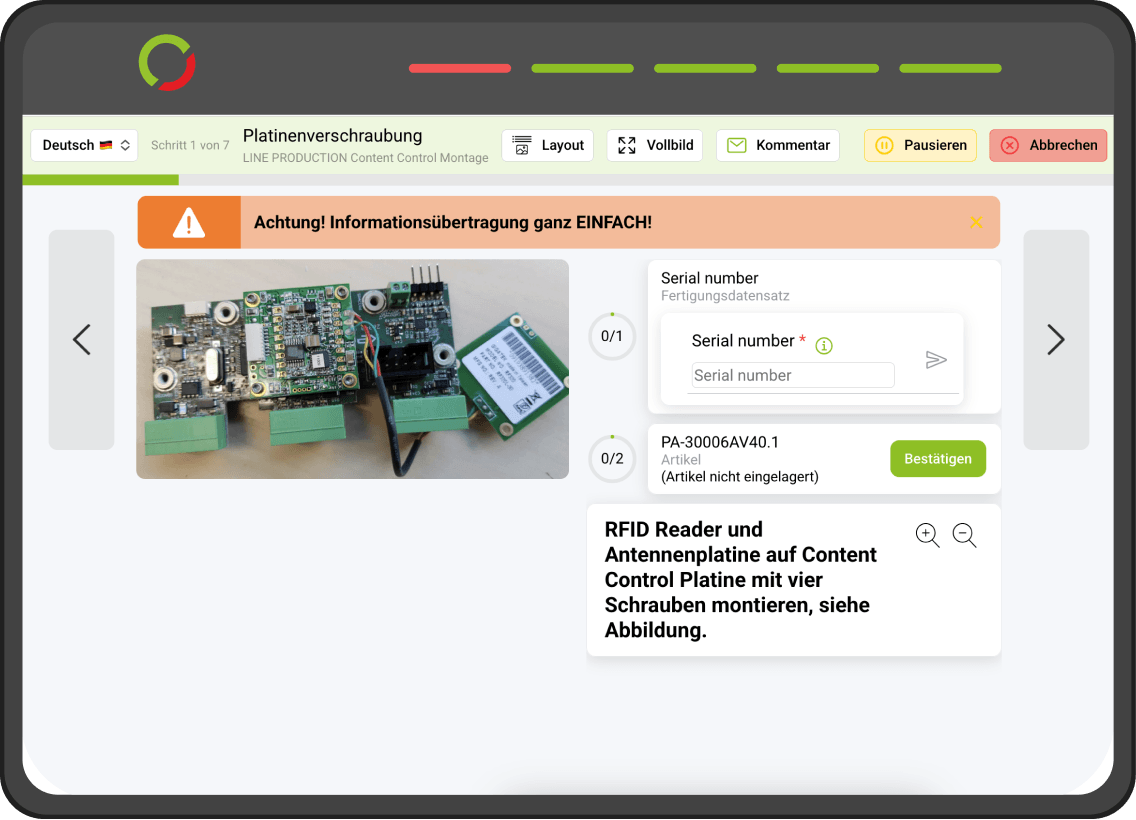
Pick-by-Light rarely unfolds its full effect alone, but in combination with the digital work instruction. The light shows which part to pick, while the instruction guides step by step through the actual assembly. Together, they create a continuously guided process in which material removal, work step and evidence interlock. Reaching into the correct compartment and carrying out the correct step thus become one connected, secured sequence, instead of two separate operations.
When Pick-by-Light Pays Off
Not every assembly workstation needs Pick-by-Light. The investment is particularly worthwhile under conditions that increase the risk of error.
- High variant diversity with many similar-looking parts, where mix-ups happen easily
- High error or rework costs, where avoided mistakes quickly pay for themselves
- Frequently changing or newly trained employees, who benefit especially from clear visual guidance
- Short onboarding times, in which complex processes must quickly be mastered reliably
- Processes with a fixed, critical sequence, where one step must strictly precede the next
Conclusion: Preventing Errors Instead of Discovering Them
Pick-by-Light is far more than a picking aid in assembly. It shifts error prevention to the beginning of the process, to where the pick happens, instead of to the end, in final inspection. Whether it supports efficiently or locks strictly is a deliberate design decision based on the intended goal. As part of digital worker guidance, Pick-by-Light becomes a building block of an assembly process in which errors are no longer discovered, but avoided from the outset.
How Pick-by-Light can be implemented concretely as a guided assembly system is shown in the overview of Pick-by-Light worker guidance.
FAQ
How does Pick-by-Light prevent assembly errors?
By guiding the employee to the correct part with a light signal and immediately detecting a mispick. With strict guidance, the process stops at an error until it is corrected, so the wrong part never gets installed in the first place.
What is the difference between Pick-by-Light and Pick-by-Voice?
Pick-by-Light guides through visual light signals at the material compartment, Pick-by-Voice through spoken instructions via headset. In assembly, visual guidance often has the advantage because it points unambiguously to the correct compartment and can be coupled with process locking.
Is Pick-by-Light also suitable for small batch sizes?
Yes. Especially with high variant diversity and small batch sizes, Pick-by-Light shows its strength, because it clearly guides to the correct part at every change, avoiding mix-ups without requiring the employee to memorize every variant.
Erfahren Sie, wie SETAGO Ihre Produktionsprozesse optimieren kann.
Demo vereinbaren