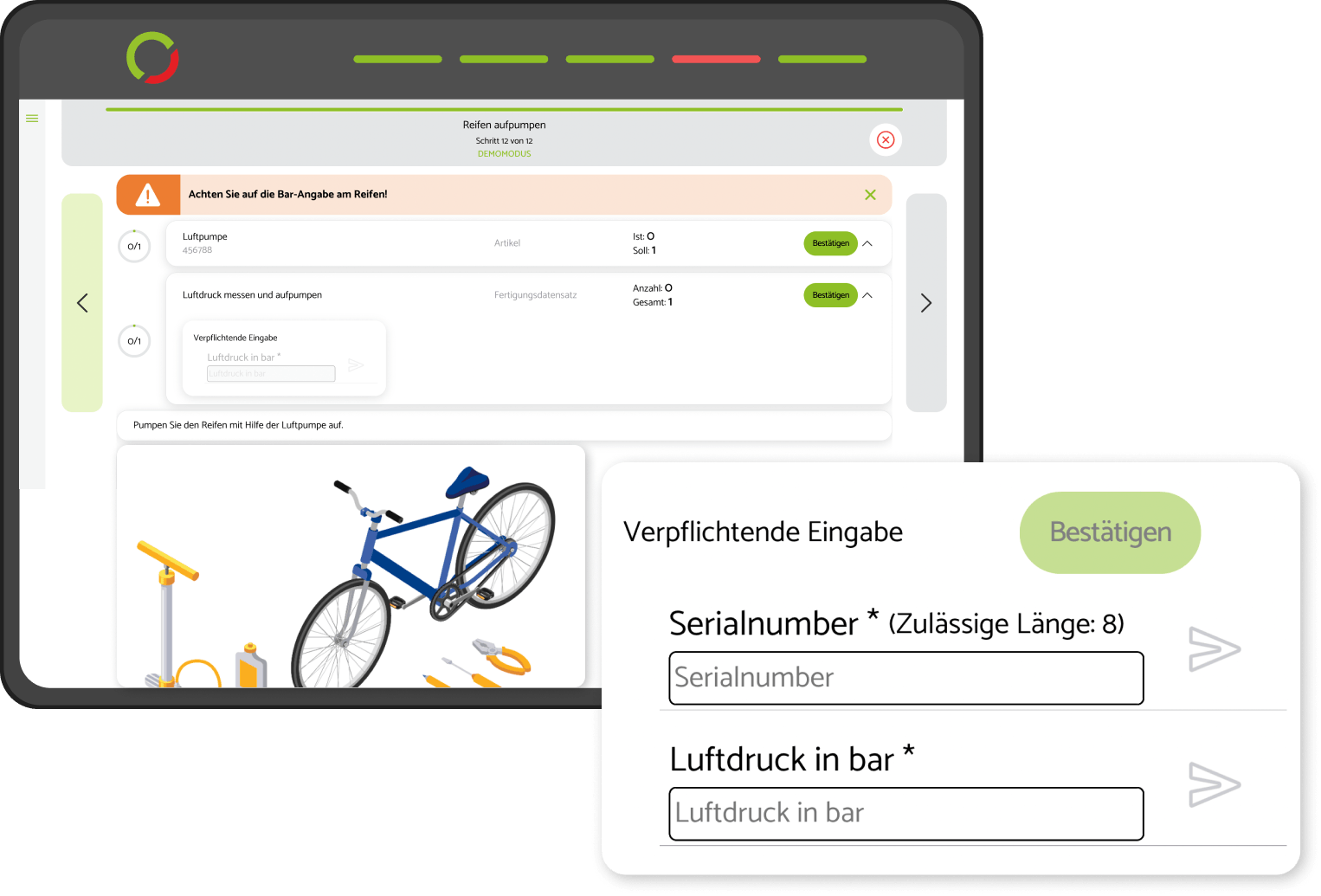
Quality Assurance in Work Instructions: Inspection Steps and Quality Gates
How inspection steps within the task stop errors before they move on
Quality that is only inspected at the end of production is expensive. If an error passes through several work steps before it is noticed, it is already built into the half-finished product, and the rework affects not just one step, but the entire chain before it. It is far more effective to secure quality where it originates: directly within the work step. This is exactly what inspection steps and quality gates achieve in the digital work instruction. This article shows how guided quality assurance works within the process and why it is more than just an additional check.
From Final Inspection to In-Process Checking
In classic quality assurance, a downstream inspection station checks whether the finished product meets the requirements. The disadvantage lies in the timing: errors are detected late, often only once the defective component has long since been processed further. Worker self-inspection therefore shifts the check to the place and moment where the error originates. The employee checks critical characteristics directly during execution and immediately recognizes deviations. This prevents a defective part from ever reaching the next step in the first place. A subsequent check becomes continuous safeguarding.
What a Quality Gate Means Within the Work Step
A quality gate is a defined checkpoint that decides whether the process may continue. In classic use, such gates sit at major milestones. In the digital work instruction, the same principle can be applied much more finely, namely directly within the individual work step. The next step is only released once the required inspection criterion has been met and confirmed. The quality gate thus moves from the project level down to the level of the individual action, where it catches errors immediately instead of only discovering them collectively at a late gate.
The Building Blocks of Guided Quality Assurance
Guided quality assurance is made up of several elements that can be integrated directly into the work step.
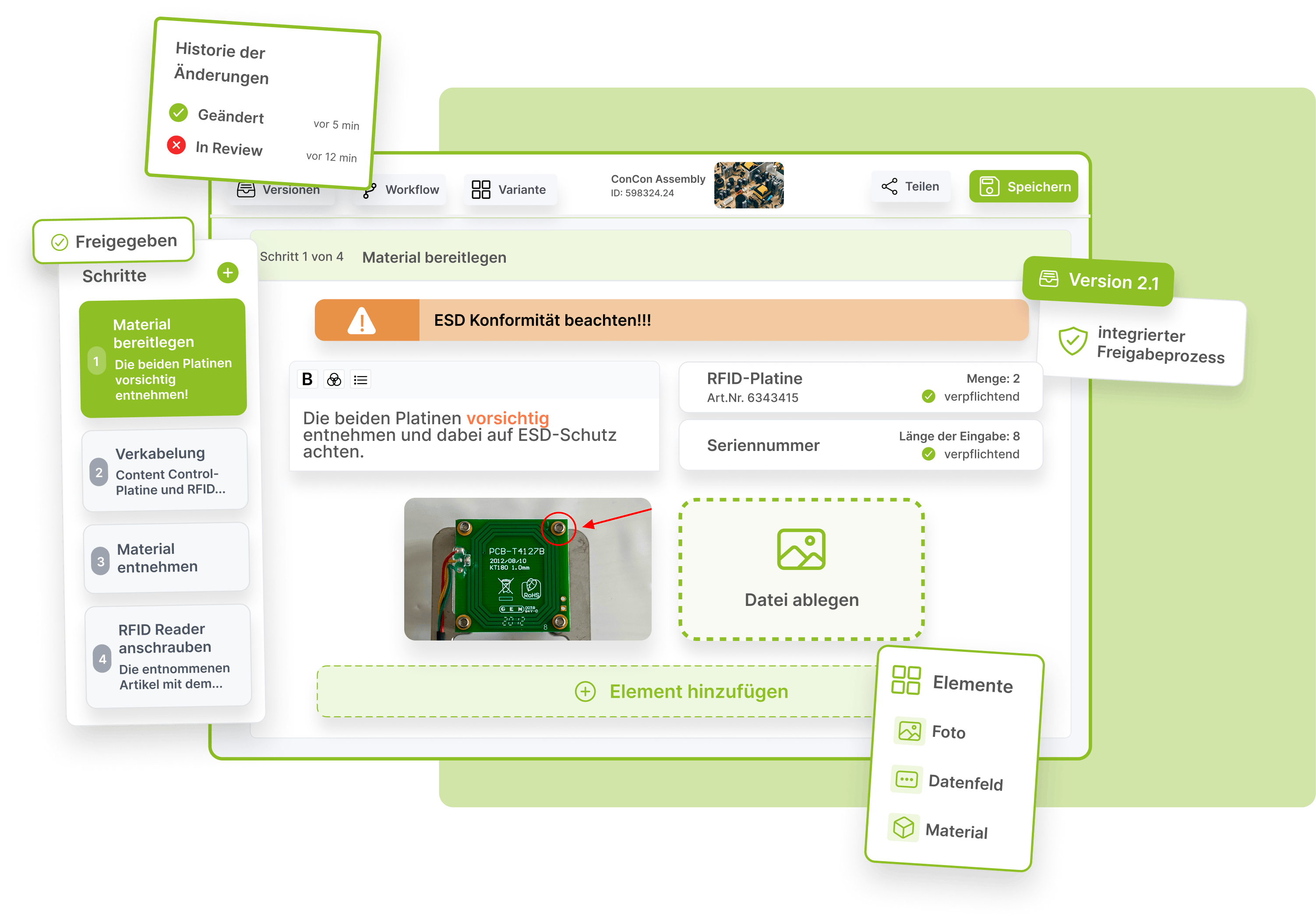
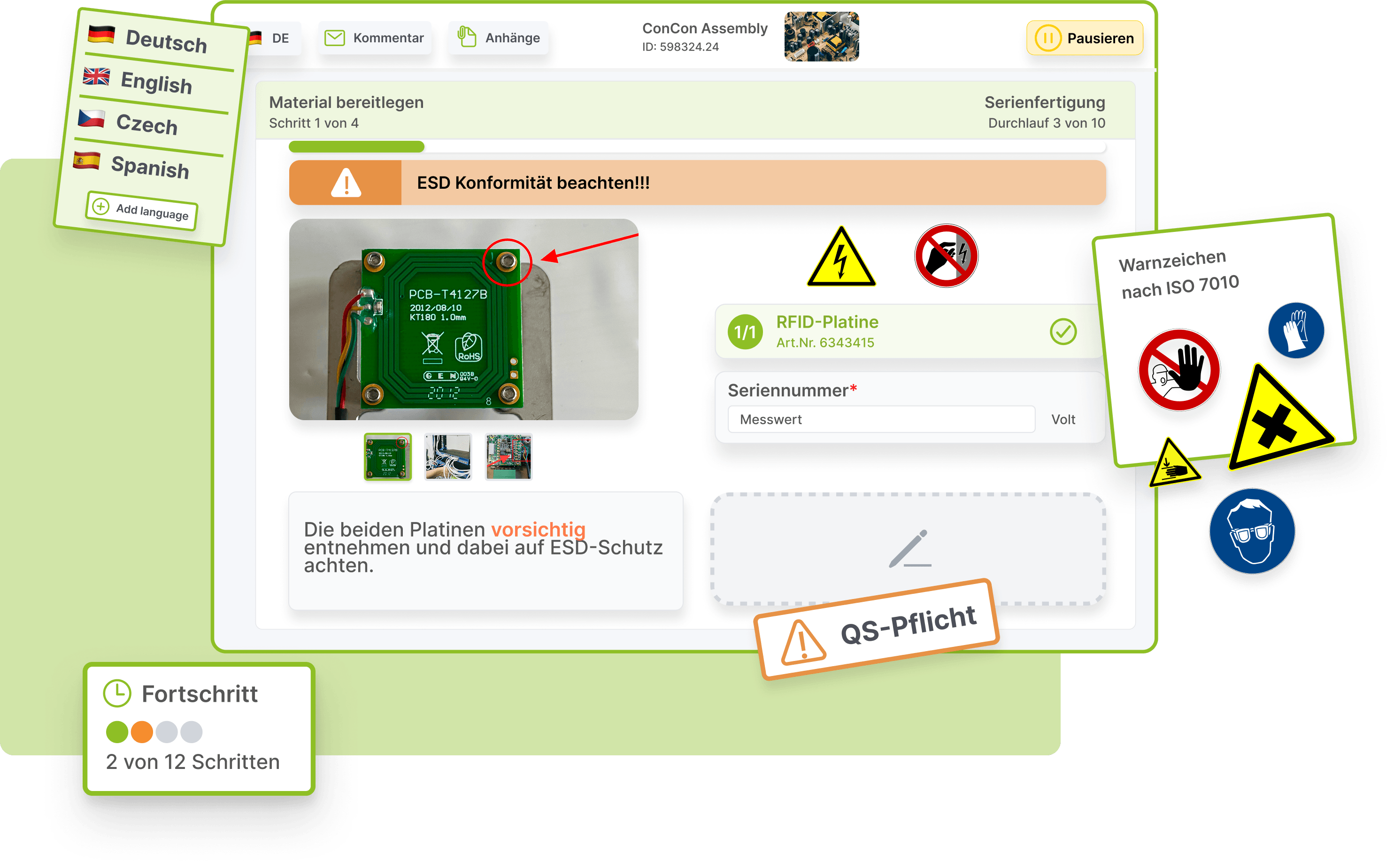
- 1Mandatory checkpoints: At critical points, the instruction requires a deliberate check and confirmation. Without it, the process cannot continue, so no inspection step is skipped.
- 2Measured values with tolerance checking: Captured values are immediately checked against stored tolerances. If a value falls outside the range, it is detected and reported right away.
- 3OK/NOK logic: Every checkpoint leads to a clear decision. An NOK result can specifically steer the further sequence, for example into a correction or special handling.
- 4Photo and scan evidence: States, serial numbers, or batches are documented directly within the step, serving as verifiable proof of the inspection performed.
- 5Locking logic on deviation: If a critical characteristic is not met, the process can be specifically locked until the deviation has been addressed. This prevents a defective part from being passed on.
Defect Capture and Inspection Records in the Same Workflow
An important advantage of guided quality assurance is that inspection and documentation do not run separately. If an error is detected, it can be captured directly within the work step, with type, location, and cause, very much in the spirit of a digital defect log. Likewise, the inspection record is not created as a separate document afterwards, but is generated automatically while the check is being carried out. Execution, inspection, defect capture, and evidence thus come together in a single workflow. This not only reduces effort but also creates a complete, analyzable data basis from which recurring error patterns can be identified.
Doesn't Additional Inspection Cost Time?
A common objection is that additional inspection steps slow down the takt. Looking at a single step, that is true, but the calculation falls short. The sum of all inspection steps is usually considerably lower than the effort for rework, scrap, and complaints that arise when an error goes undetected and continues through the process. Guided inspection within the process is therefore not extra burden, but an investment that pays off through avoided follow-up costs. What matters is placing inspection steps specifically at critical points, instead of checking everything across the board.
Conclusion: Quality Is Created in the Step, Not in the Inspection
Inspection steps and quality gates in the digital work instruction shift quality assurance to where quality actually originates: within the individual work step. Errors are stopped early, evidence is generated automatically, and the data reveals where quality can be systematically improved. Quality assurance thus stops being a downstream check and becomes a fixed, guided part of the process itself.
How execution and documentation fundamentally come together in one digital workflow is explored further in the article on merging work instructions and inspection records.
FAQ
What is the difference between worker self-inspection and final inspection?
With final inspection, the finished product is checked at a separate station, usually at the end of the process. With worker self-inspection, the employee checks critical characteristics directly during execution. Errors are thus detected earlier, before a defective part is processed further.
What is a quality gate in manufacturing?
A quality gate is a defined checkpoint that decides whether the process may move on to the next step. In the digital work instruction, this principle can be broken down all the way to the individual work step, so errors are caught immediately.
Do inspection steps slow down production?
The individual inspection step costs time, but the sum of inspection steps is usually lower than the effort for rework and complaints caused by undetected errors. What matters is placing checks specifically at critical points.
Erfahren Sie, wie SETAGO Ihre Produktionsprozesse optimieren kann.
Demo vereinbaren